

What you need to know about Site Readiness to accelerate the deployment of your technology systems.
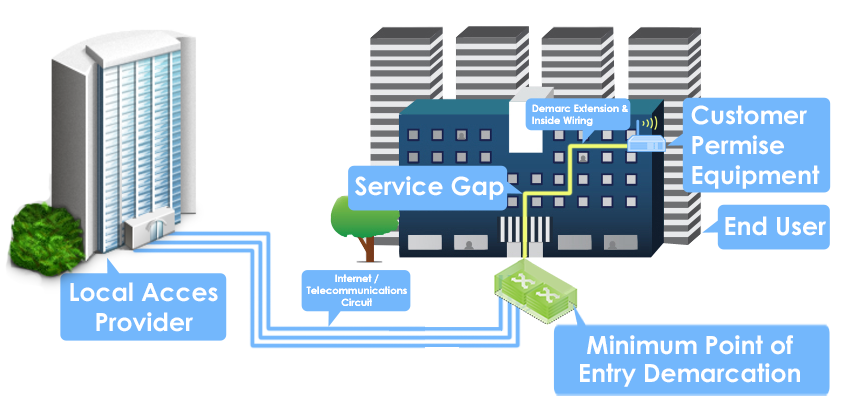
The deregulation of the telecommunications industry over the past 30 years has increased the difficulty of installing the extensive cabling needed by modern businesses. This problem primarily results from confusion over which party has responsibility for delivering a particular telecommunications service to a given facility. The process of delivering these services in a timely manner requires a thorough understanding of the demarcation extensions within the premises, including the equipment needed to complete the transmission path. This complexity increases the value of a Managed Service Provider (MSP) who specializes in providing onsite technology services to achieve a reliable deployment.
Demarc Extension Defined: A demarcation extension, commonly known as a demarc extension, is the transmission path for a telecommunications circuit that originates from the Local Exchange Carrier’s (LEC’s) interface and ends at the termination point before the Customer Premises Equipment’s (CPE’s) interface. The demarc extension may also include the equipment needed to complete this transmission path, such as patch cords and media converters. Additional terms synonymous with demarc extension include CPE cabling, circuit extension, inside wiring, and riser cabling.
MPOE: A facility’s demarc point is often called the minimum point of entry (MPOE) to emphasize the fact that it should occur as soon as possible after entering the facility. A circuit is typically delivered to the MPOE, which should be the closest point at which it is practical to deliver the circuit after the cable enters a building or the point at which the cabling crosses the property line. In some cases, however, the MSP must deliver the circuit to the minimum point of penetration (MPOP), which is essentially the LEC’s drop-off. The MPOP is typically located outside the facility, which requires greater expertise than delivering a demarc extension within a facility.
In addition to the technology expertise, an MSP typically provides certified project management skills to manage stakeholders in the supply chain. The supply chain of a telecommunications circuit routinely involves multiple stakeholders, making it important to distinguish their specific roles, which are as follows:
- Interexchange Carrier (IX): Commonly referred to as the Telecommunications Carrier or Service Provider, IX operates the wide area network connectivity and Internet access. Typically, they are the primary contracted provider of the long-haul circuit and will resell the services of a local exchange carrier to deliver services up to the customer’s premises.
- Local exchange carrier (LEC): LEC provides access to a public switched network, and may also be known more specifically as a competitive local exchange carrier (CLEC) or an incumbent local exchange carrier (ILEC). To deliver a complete circuit, it takes the combination of the long haul or Internet services provided by the telecommunications carrier and the local tail circuit they provide. So if the telecommunications carrier is the airline that takes you between LAX and JFK airport, then the LEC is the local shuttle bus that connects you from the airport to your house in downtown Manhattan.
- Facilities manager: Also known as a building manager, the Facilities Manager ensures that the facility is able to perform its designated functions, which typically include basic telecommunications services and operation of the building’s Minimum Point of Entry. Access arrangements and other ordinance clearances must be coordinated with the facility manager or landlord to get the circuit from the carrier drop-off point to the customer’s location in the building
- Managed Services Provider (MSP): An MSP is a third party vendor that can assume the End Customer’s responsibility to manage their Site Readiness; including cable installation and a set of other related Information Technology (IT) services that are defined by the customer.
Though the FCC intended to promote competition and offer customers more options and choices, it mostly introduced a lot of confusion by relaxing the rules on demarc extensions. This current confusion over demarc responsibilities, poor installation practices, and lack of standardization have negatively impacted the telecommunication industry. These problems have often caused delays in service delivery due to disagreements over responsibility and unnecessary visits by onsite IT support services.
Let’s break down these challenges
The gap that commonly exists between the readiness of the telecommunications carrier and the customer’s site creates a range of challenges in providing the site with demarc extensions. Some of them are discussed here:
- Edge Customer Premises Equipment (eCPE) is typically in a different physical location than the demarcation point and the MPOE at the customer’s premises or office building. Closing the connectivity gap between these two points may require intricate access to more than one area of the facility and a tricky navigation through the building walls and conduits to install the cabling and other equipment that is required to complete the demarc extension. In many cases, it may also be necessary for the installer to access multiple telecom closets.
- Requires a high degree of coordination between multiple parties, especially the LEC and the telecommunications carrier, for the rapid installation of a demarc extension. It is ideal for the telecommunications carrier to schedule its service ready date in line with the firm order commitment (FOC) date provided by the LEC. The FOC is the date when the LEC will deliver the local loop for the circuit at the site. It is ideal for the customer site to have been ready prior to this FOC date to facilitate smooth service activation. This is not the case most of the time as customers are unaware of the demarc extension requirements and only schedule site readiness after notification from the carrier that the service is ready for use from their end.
- Standardized cabling installations processes including proper tag-and-locate tickets for each circuit must be followed for easy service identification, monitoring, and fault resolutions. Missed or improper tagging by DIY or casual installers could cause delayed service activation and challenging fault resolution.
- Congested pathways in stacked telecom closets that have core holes must have adequate fire stopping if previous installers have failed to do so. In many cases, the lack of available riser pairs due to previous installations prevents technicians from extending the circuit.
- Installing demarc points in large facilities that comprise multiple buildings can be especially challenging. For example, the individual schools in a school district typically must connect to a central point, such as a data hub that hosts the demarc point for the entire district. This requirement often results in a significant technological gap between the schools in that district.
How do you go about this delivery process today?
Customers have a few ways of getting their piece of the puzzle completed to ensure timely service initialization. The mostly used three primary delivery models for onsite services are:
- Customer-managed delivery. Customers perform their own extension wiring and site setup. They are generally responsible for resolving any network difficulty that resides on the Local Area Network (LAN) side of the demarc point, including the CPE. The LEC is generally responsible for resolving network problems on the Wide Area Network (WAN) side of the demarc point.
- Telecommunications Carrier-managed delivery. The telecommunications provider partners with an MSP like ExterNetworks to help them deploy the circuit. This model provides an effective solution for building and supporting an enterprise-level network. A project manager typically serves as a single point of contact for the customer.
- MSP/Service Integrator-managed delivery. The MSP provides integrated services for the customer by managing all the pieces and vendor deliveries needed to deliver the circuit and initialize the service. This delivery model requires the MSP to verify each contractor to ensure best results. In some cases, customers can manage some of the vendors directly and use the SI to integrate some of the services like demarc extension. Expert service integration can reduce delivery times and minimize service interruptions.
The solution to Avoid Delays in Getting Your New Bandwidth Up and Running
- The CIO and Network Managers can effectively meet the challenges of installing a demarc extension by retaining an MSP’s Service Integrator-managed delivery to do the following:
Implement and manage all aspects of the demarc extension, allowing underlying providers and their enterprise IT staff to focus on their core competencies.
Use their specialization in demarc extensions for a reliable service activation and to minimize the number of truck rolls needed to complete an installation, which accelerates the deployment of the installation and reduces its costs.
- If the End Customer or Enterprise CIO who ordered the telecom circuit isn’t requesting the facility manager to install it, the best solution may be the Telecommunications Carrier–managed delivery model. The telecommunications carrier can rely on the MSP to provide the circuit. This delivery model is especially useful if the telecom provider is unable to install wiring past the demarc point.
Conclusion
Considering all the complexities that are involved in navigating the multiple providers and technology expertise required for Site Readiness, it is recommended that customers use the services of an MSP such as ExterNetworks. Regardless of whether an MSP or a Telecommunications Carrier-managed delivery model is used, customers must always ensure that some key services that are fundamental to a good ISP is a within the providers capabilities; such as:
- Structured cabling services can reduce the initial cabling cost by increasing the efficiency of the installation and allowing the network infrastructure to easily expand in the future. The Customer-managed delivery model is typically best for these services, wherein the customer directly hires an MSP with expertise in cabling.
- Staging and configuration services to integrate and configure new equipment into an existing network, which is typically a time-consuming task. The Service Integrator-managed delivery model is often best for these services, due to the variety of equipment that’s usually required.
- Site survey and network assessment services include monitoring networks to identify traffic bottlenecks that can affect reliability and availability. The expertise needed to properly develop the best network strategy or provide network optimization for an existing network means that the Service Integrator-managed delivery model is frequently the best choice for these services. However, the Service Integrator-managed delivery model is also used to provide network assessment services in many cases.
- Thorough testing is another area that benefits the end customer or CIO. Most MSPs perform only minimal testing when installing a demarc extension, whereas ExterNetworks performs all-encompassing circuit testing. For example, an MSP should test the entire circuit rather than just its extension portion by connecting the circuit directly to the LEC’s testing center. This additional testing ensures that the circuit is functioning properly prior to customer acceptance.
ExterNetworks is a nation-wide provider of Managed Services for ISPs and their customers offering end-to-end Network and Infrastructure Management services for Site Survey and Site Readiness. We will be happy to discuss ways in which we can support you in delivering a one-stop-shop or referral managed service solution to enhance the SLAs and value-ad stickiness to end-users. For inquiries you can reach us through contact us page or connect with us at Twitter, Facebook, or LinkedIn.
© Copyright ExterNetworks Inc. | All Rights Reserved.